The product
DilliC features: planning and change management, on one set of figures.
Planning works out what matters to your organisation, measures where you stand, and chooses what to do about it. Change management runs the work that carries it out. Both read the same organisation, the same people, and the same figures.
Everything below is in every plan. The screens are from Northwind Logistics, the demonstration organisation, which you can open from the sign-in page.
Planning
Strategic planning: measure, explain, choose
Your organisation, as it is. You name the levels, Company, Division and Team or whatever yours are, and place each part under the one above it. Sibling weights are declared by an administrator and must total a hundred, so a division that is 45% of the company moves the company's score by 45% of its own change, not by a third because there happen to be three divisions. A role held on a parent applies to every part beneath it, and never upward.
Factors and objectives. Each part proposes the factors that decide its success, votes and comments on them, and accepts the ones that matter. An accepted factor carries an objective, a measure with a target, and the services it evaluates. Rewording a factor asks what kind of change it is, so the history stays honest.
The assessment. Accepted factors freeze into a survey. People inside answer it, and customers and partners answer it too, invited by link and without a seat. Answers are anonymous by construction. The results draw as a four-quadrant matrix, with the agreement among respondents beside every factor.
Roll-ups that mean something. A composite at the division merges the teams' results, weighted, with each part still visible. A KPI that several teams share can be read for the division too, summed, averaged or weighted as its own definition says. Where the division has a figure of its own, the roll-up sits beside it and never replaces it.
A plan for one service. A part that runs several services need not blur them into one plan. A factor, an assessment, an initiative, a risk and a planning-interval objective may each belong to one of its services, and what belongs to none is the part's own plan. The part reads its own figures beside what its services add up to: the shared measure, the budget in a pile for each service, and a composite of the services' assessments. Services may be weighted among themselves, and count equally where they are not. Each service's page shows its own plan.
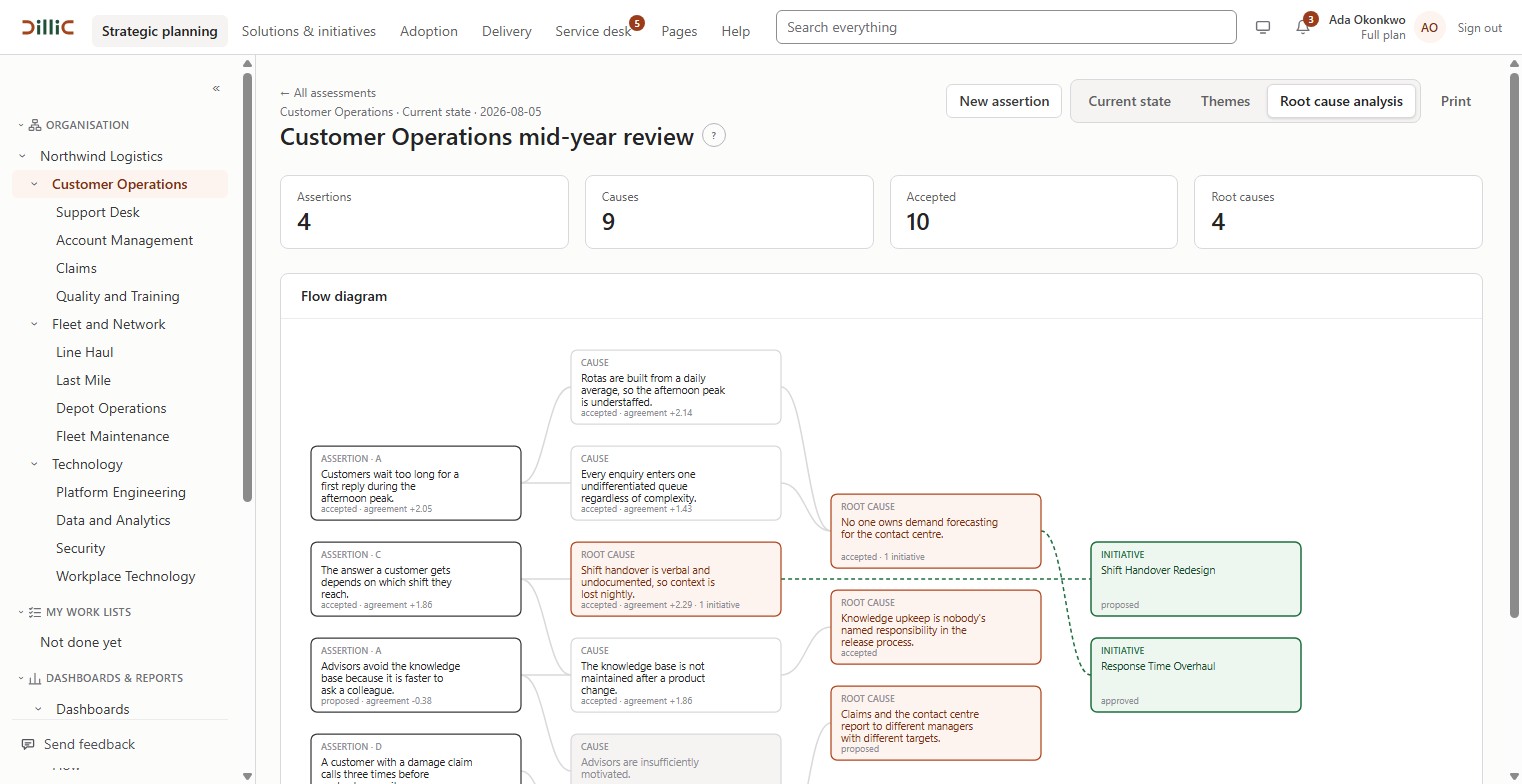
Root cause analysis. Ask why until nothing is left underneath. Assertions attach to factors, causes hang off assertions, and the root causes link to the initiatives that address them. A cause may cite the desk's incidents and problems as evidence.
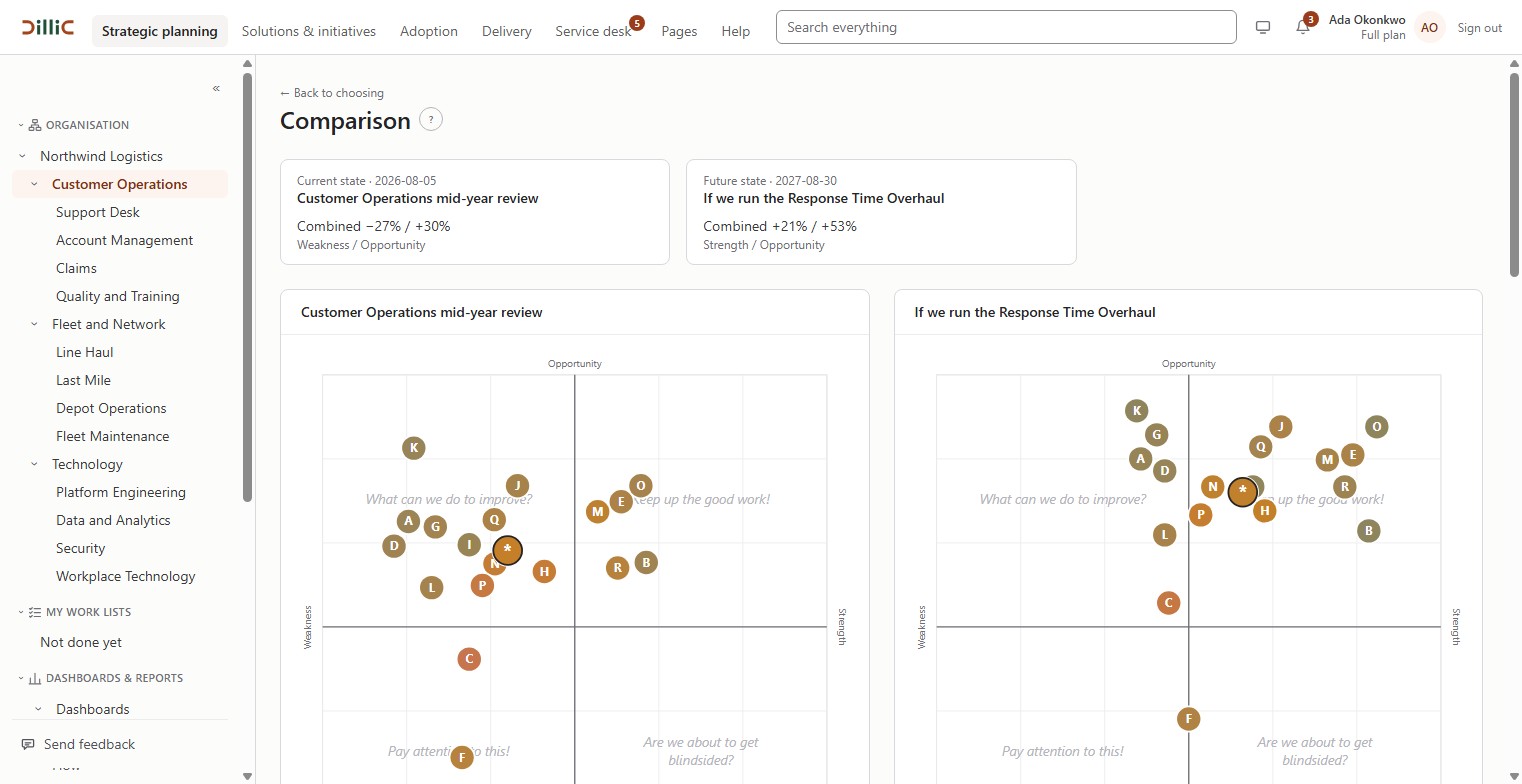
The comparison of futures. The same factors, answered as if a potential solution were implemented. Assessments sit side by side to identify which solution will best achieve the desired future state, so the difference is a measurement rather than a retelling.
Change management
Change management: govern, deliver, evidence
Boards and sprints. Scrum and Kanban boards with limits on the columns, a backlog, sprints with burndown and burnup, velocity, cycle time, flow efficiency, and where the work went. Epics in colour, work in groups, and a question mark beside every heading that explains the screen.
The workflow is data. You name your statuses and declare the moves between them. Each status says what it means, as one of seven states, so reports count across teams with different names for the same step. A move may wait behind an approval gate, and a cancel or an emergency path may start from any status.
Prioritisation, your way. A priority set by hand, RICE, ICE or WSJF, chosen per kind of work. Custom fields an organisation writes for itself. A risk register with owners and answers, read for one team or for a division and everything beneath it, and dependencies across teams.
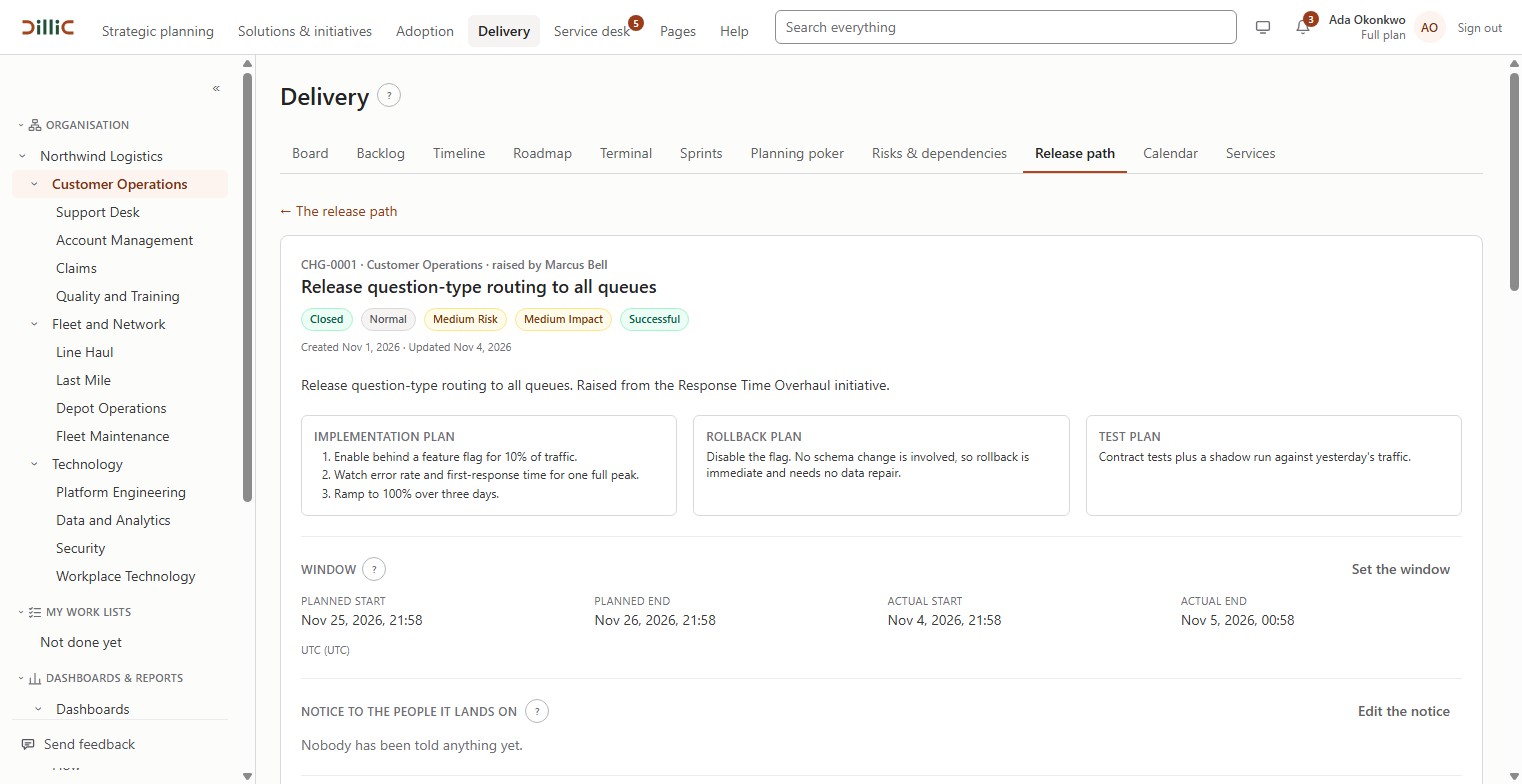
ITIL 4 change enablement, end to end. Assess risk and impact, write the implementation and rollback plans, take it to the change authority, schedule it, implement it, and record what happened. A library of change models holds the plans, services and risk answers for each kind of change you repeat; a standard model is the pre-authorisation, and its changes skip the board. A normal one cannot, and authorisation without plans is refused. A risk questionnaire scores the change and chooses the authority.
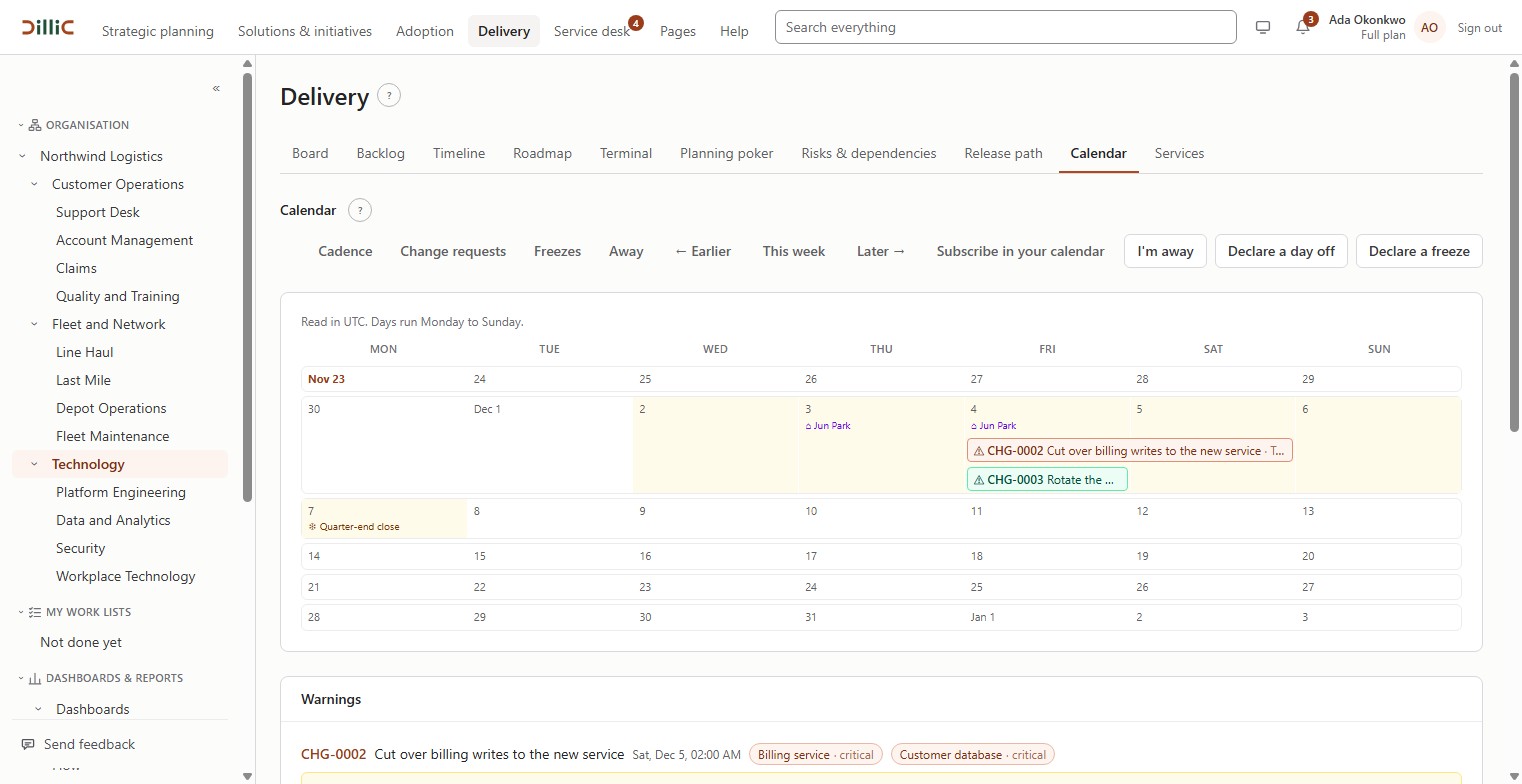
A calendar that warns, and tells. Changes sit on a calendar with the services they touch. A collision with another change on the same service, or a window inside a freeze, is a warning before it is a problem. Each person can subscribe to the calendar from Outlook or Google Calendar. A change carries a notice for the people it lands on, and once announced it appears on the service desk portal and on the service's page.
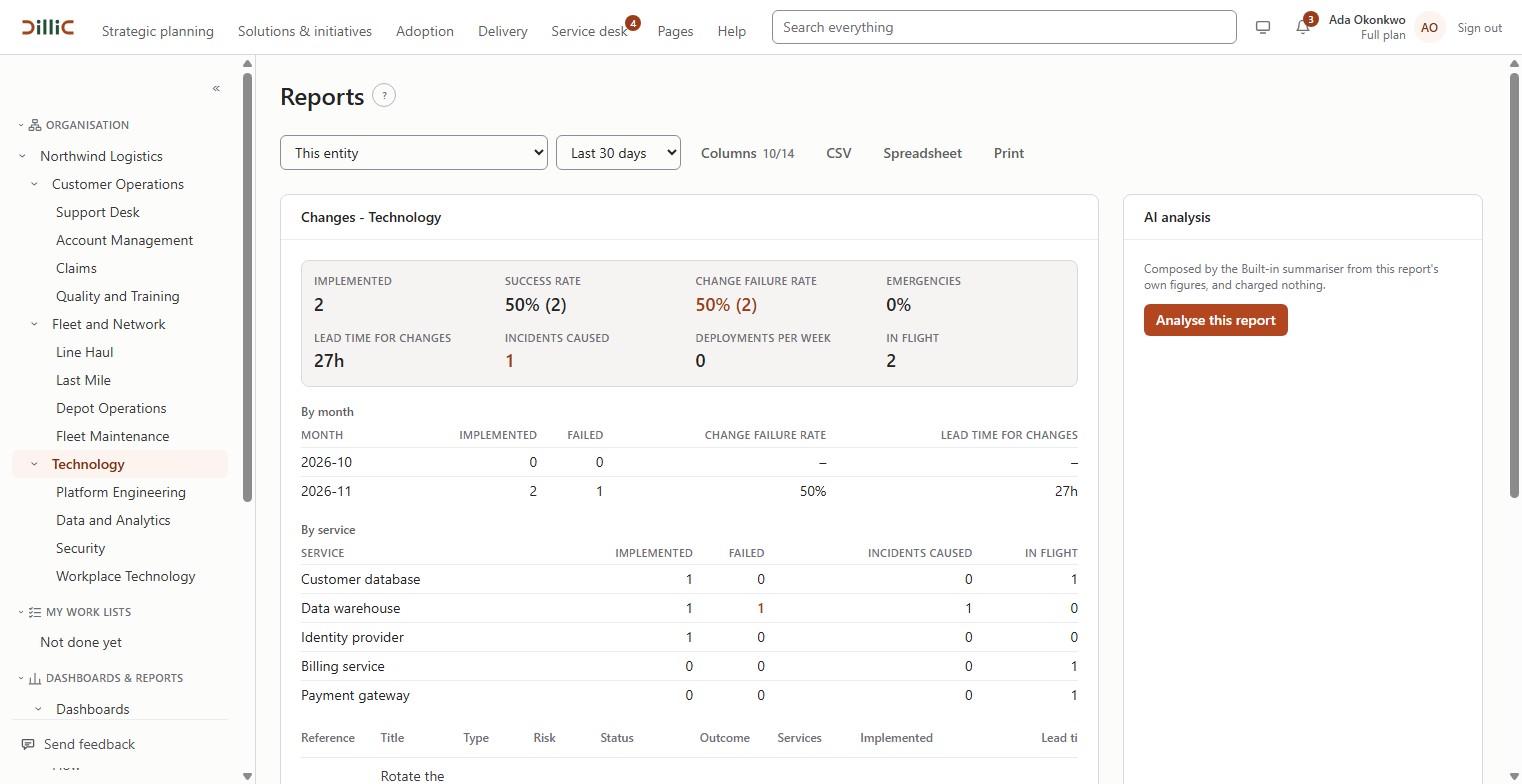
Releases, deployments and the DORA figures. A release path names versions and the change requests that cover them. Deployments arrive from your pipeline. The change report gives lead time, change failure rate, deployments per week and incidents caused, by month and by service.
Service desk
A service desk, where the loop reports back by itself
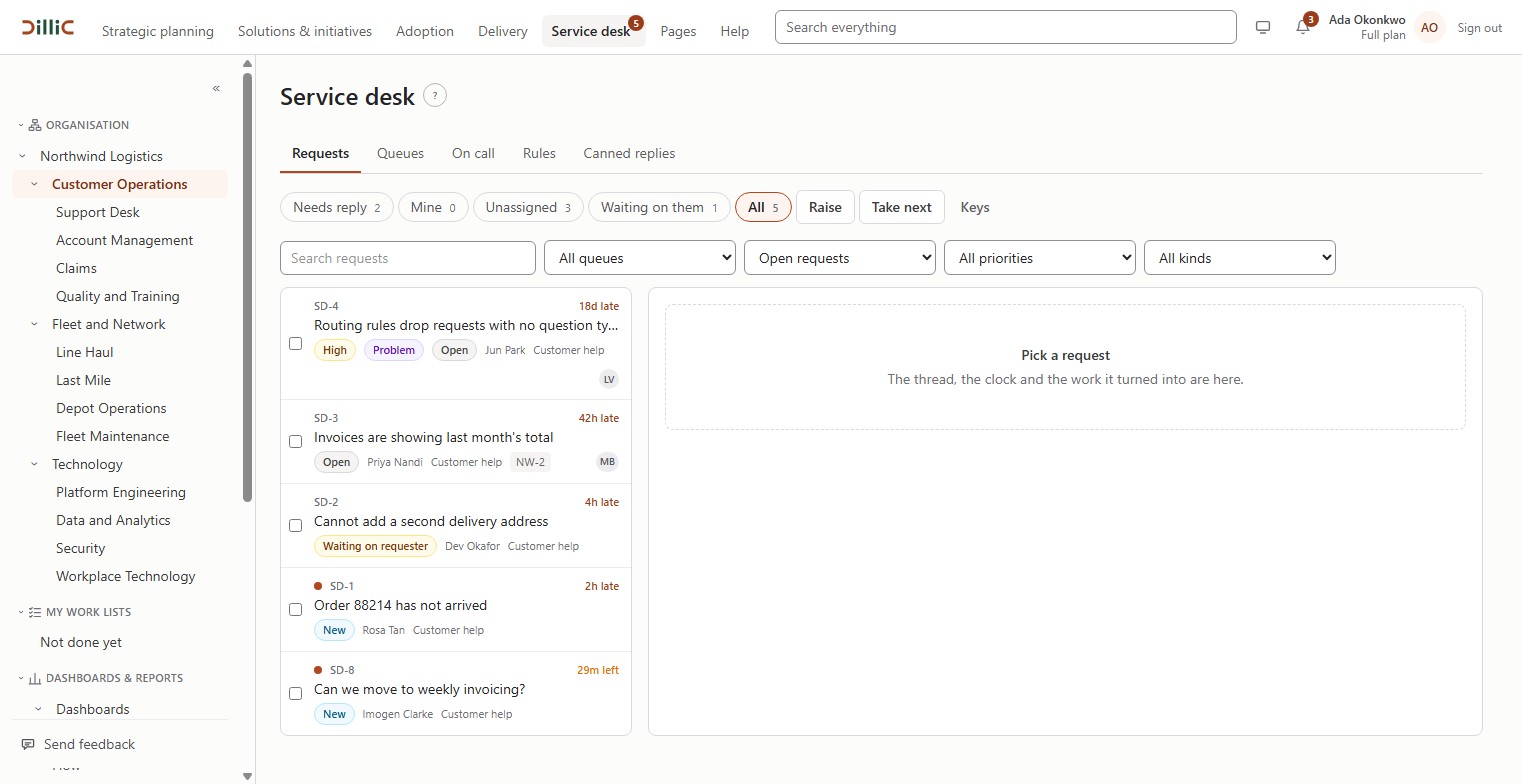
A portal that needs no seat. Requesters raise and follow requests through a portal of their own, or by mail. Queues, routing rules, canned replies and clocks for the promises you make. An agent takes the next request and sees the thread, the clock and the work it turned into.
Incidents and problems, tied to changes. An incident names the services it was about and the change that caused it; a problem gathers several and names the change that fixes it. Satisfaction is rated on what was resolved. Knowledge base articles come from Pages, so the wiki answers the desk.
On call, chat, and what is running. A rota says whose turn it is, and an escalation policy pages a major incident up the line until somebody acknowledges it. People raise a request from Slack or Microsoft Teams and are answered there. A cloud account, a cluster or a Terraform state reports what it runs, and whoever keeps the services accepts what is one.
In step with the desk you have. Requests and incidents sync both ways with the tickets of twenty-one service desks, ServiceNow, Jira Service Management, Zendesk, Freshdesk and Salesforce Service Cloud among them. The subject, the status and the thread travel, so two desks can work one ticket.
Alerts from the monitor, or from another desk. Grafana, PagerDuty, or any system that can post a signed webhook raises an incident on the service it names, adds to it when the alert fires again, and resolves it when the alert clears. An organisation that keeps its own service desk sends its incidents the same way, so the loop closes without a migration.
Services
One service name, so each half checks the other
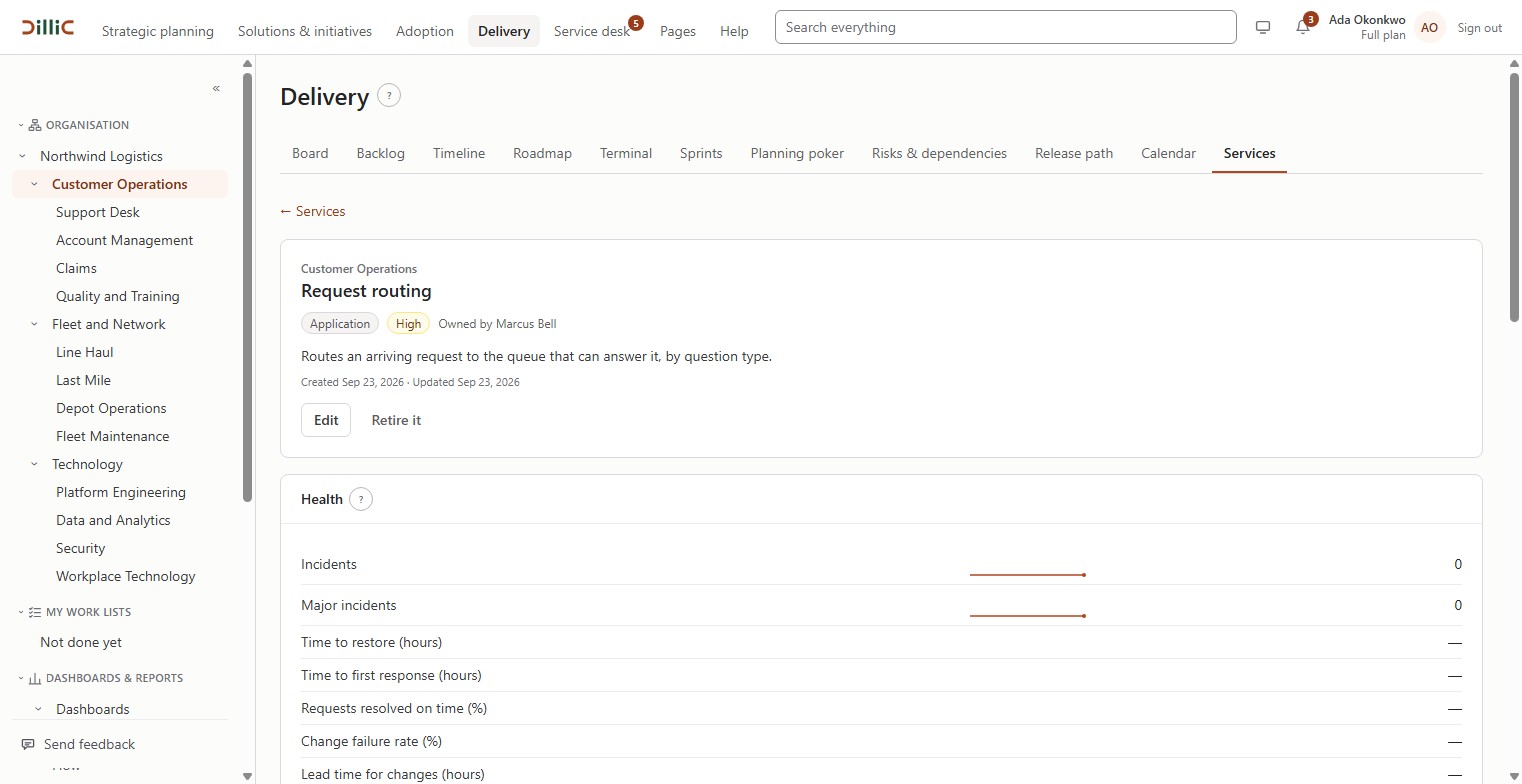
A factor names the services it evaluates. An initiative names the services it establishes, enhances or retires. A change names the services it touches, and an incident names the services it was about. One name, so the plan, the delivery and the desk check each other.
A measure on a desk, change or work figure reads itself: incidents, availability, hours to restore and to first response, requests on time, change lead time and failure rate, requester satisfaction, and cycle time. Any other measure takes a reading typed in, imported from a spreadsheet, or posted by a script from a finance system or a data warehouse. A service's page also totals the spend of the initiatives that build, improve or retire it. A repeat survey of the same factors shows what moved, and adoption says whether the change landed. An initiative whose releases touched none of its services says so, and a service taking changes that serve no initiative is unplanned. A root cause cites the desk's incidents as evidence, and the citation says what to assess next time. The loop, with real numbers.
Adoption
Change adoption: the people a change happens to
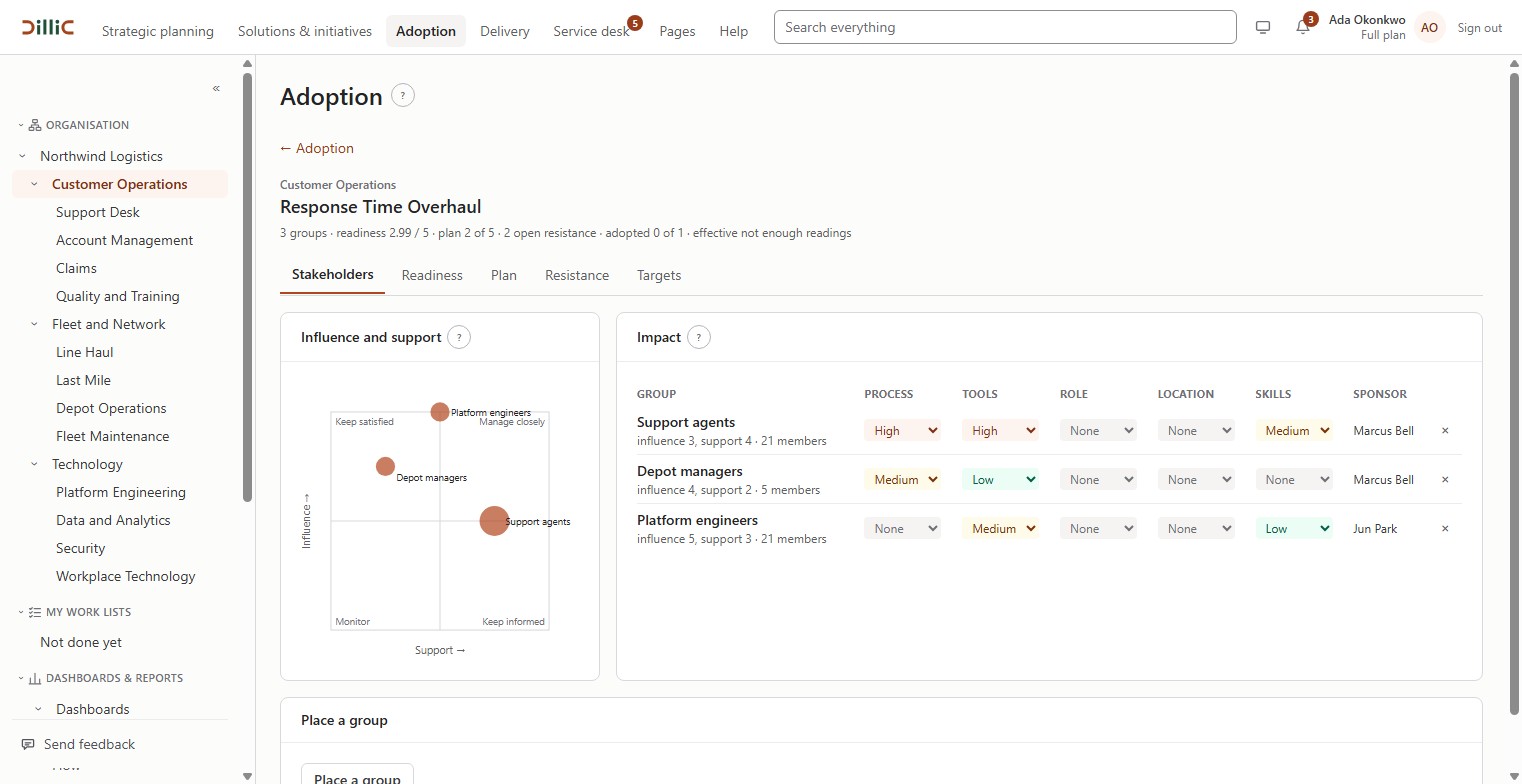
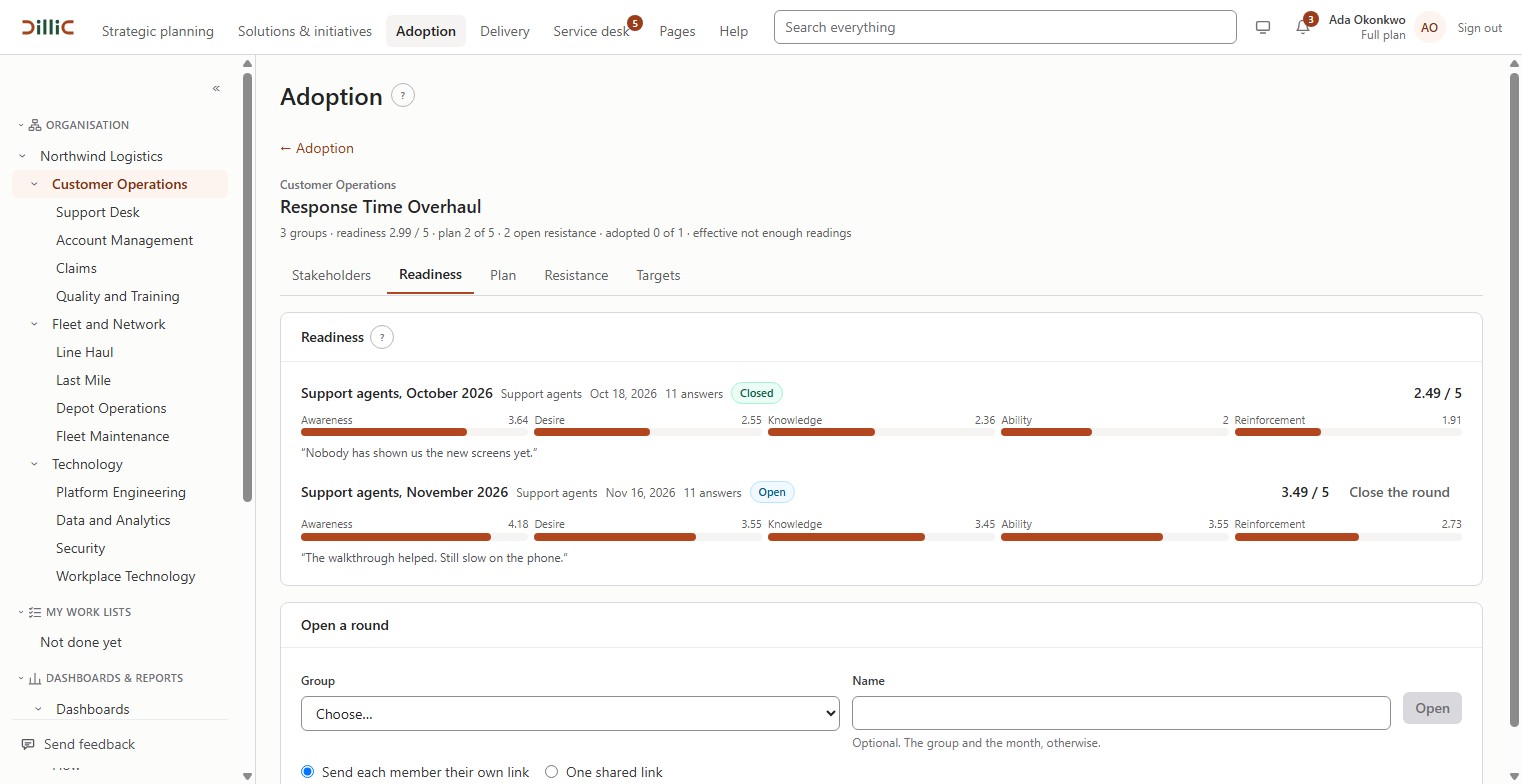
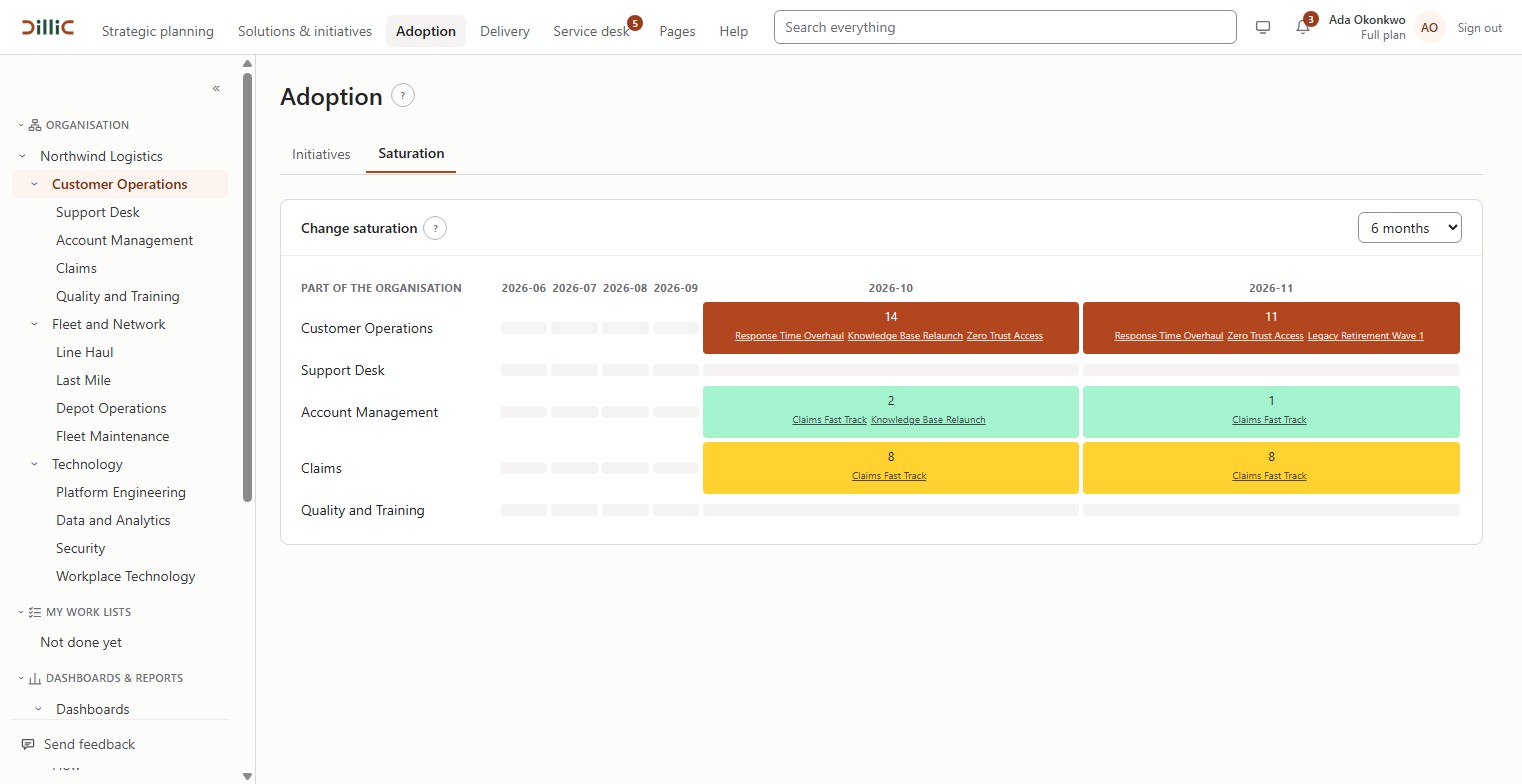
Adoption is a module of its own, beside the two halves, and it answers the question delivery cannot: did it land? Stakeholder groups sit on the influence-and-support grid with the impact on each, by process, tools, role, location and skills. Readiness rounds are answered anonymously through a shared link, and scored on awareness, desire, knowledge, ability and reinforcement. A communications and training plan, a resistance log, and adoption targets drawn from the measure library sit beside whether the initiative is effective. A saturation heatmap shows change landing on each part of the organisation before people are overloaded.
Portfolio
Portfolio funding, behind an authority
A kanban an initiative is funded through, behind a lean portfolio authority, with the hypothesis and lean business case it carries and value streams with budgets and guardrails. It sits behind the portfolio module rather than behind a framework: lean portfolio management predates the framework that packaged it, and whose job it is to look at funding is a question for the organisation, not for a level of SAFe.
Scaling
SAFe, as much of it as you run
An account chooses none, essential, portfolio or full. Essential adds planning intervals that put every team on a train onto one cadence, PI objectives with business value, a program board drawn from the dependencies the work already carries, enabler rungs, and predictability. The list is deliberately short: WSJF and the three techniques beside it, risks, velocity, cycle time, flow and the portfolio are offered to every account, and nobody should have to reach them through a framework. An organisation running SAFe uses SAFe's vocabulary, and DilliC restores your own word if you stop. The SAFe map grades every construct, and the ITIL 4 map does the same for change enablement.
Pages, dashboards and AI
A wiki, dashboards, and AI analysis of the same figures
Pages. A wiki in the product, versioned and linked to work. Every initiative has a page, and pages answer the desk as knowledge articles. A page is read by people who never open a board, so it is a module of its own.
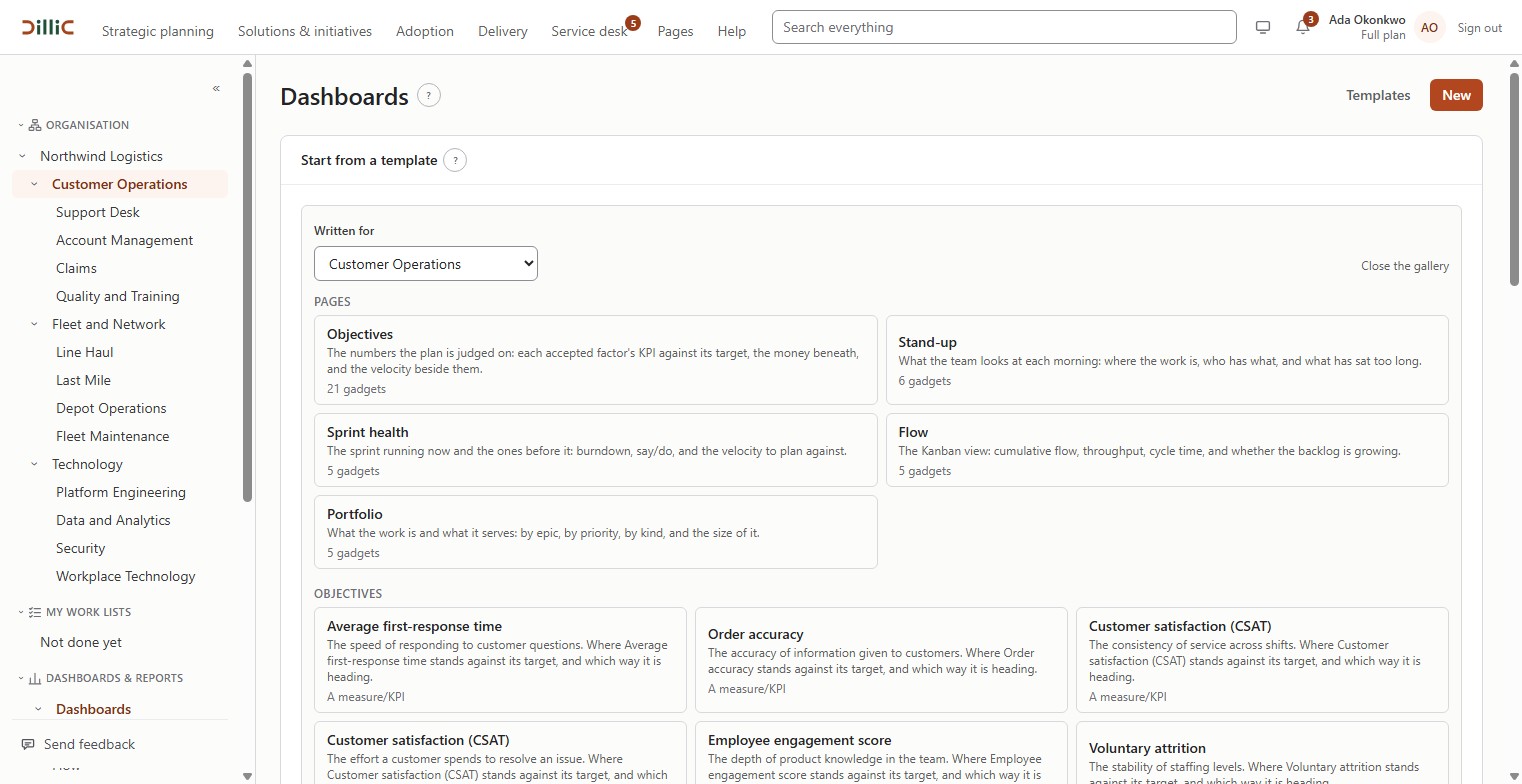
Dashboards and reports. A query language over the work, dashboards built on it from a gallery of templates, and reports on factors, assessments, root causes, the desk and change requests, each with a CSV, a spreadsheet and a print.
AI, in the seat price. Every paid seat carries 200 credits a month, and you choose the Claude model: Haiku, Sonnet or Opus. The analysis reads the same figures leaders do, on reports and dashboards, and an assistant works on items and writes its entry in the changelog under its own name. What you send is not trained on.
Automation. Rules act on the work within the permissions of whoever set them off, and no further. Outbound webhooks post what happened as signed JSON, or straight into a Slack or Microsoft Teams channel.
Enterprise identity
Single sign-on and provisioning through your directory
SAML 2.0 and OpenID Connect single sign-on, and SCIM 2.0 provisioning, so an organisation tells DilliC about a joiner or a leaver in the directory it already keeps them in. Multi-factor by passkey or authenticator app, with a policy the account sets. Roles scoped to parts of the organisation, personal access tokens narrowed to some of a person's rights and given an end date, an audit trail on every consequential change, and immutable history on every item. The trust page says the rest, and the questionnaire says all of it.
Beside what you have
Integrations: trackers, version control, and a phone app
No big-bang migration. DilliC syncs with fifty-three trackers, Jira and GitHub Issues among them, forty-eight of them in both directions, so a team's board can stay in its current tool while planning, change control and adoption move into DilliC. Import and export speak the vocabulary of twenty-seven, and statuses travel by their meaning, so Done in one tool and Closed in another both arrive complete.
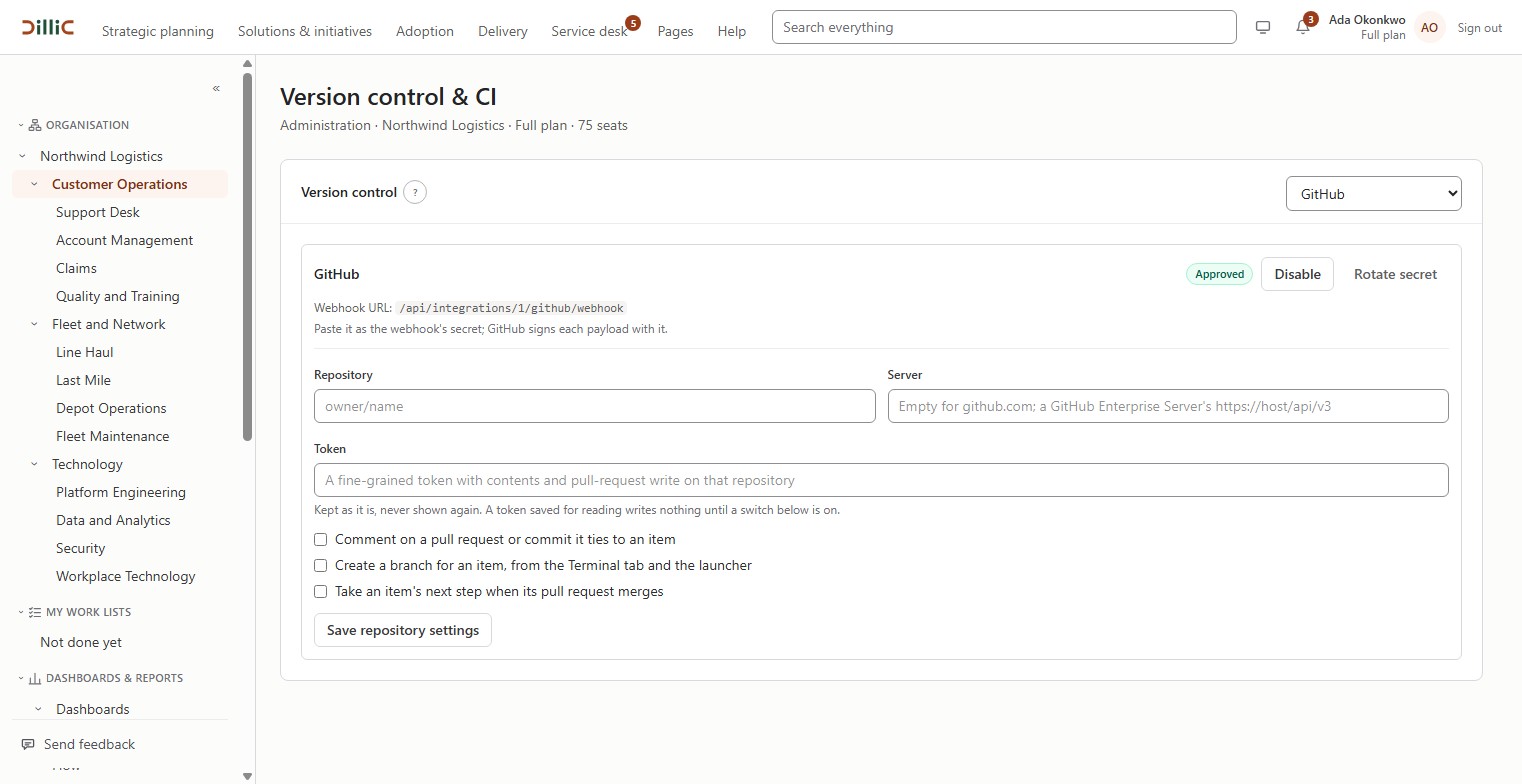
Version control. GitHub and Bitbucket webhooks tie commits and pull requests to items, and a merge can take an item's next step. Deployments arriving from a pipeline land on the release path and in the DORA figures.
A phone. The same product on Android and iOS: every screen the web app has, at the same address, signed in with a device token the Security screen can revoke, and told by push what the bell would have shown.
Your words. You rename the levels, the kinds of work, the nouns, the fields and the statuses, and DilliC shows your word on every screen. What an administrator can name and shape. Scripts use the API, which is everything the apps use. An AI assistant connects to the same API over the Model Context Protocol and works as the person whose token it holds.
See it on your own data. The two-week trial plan says what to set up each day and what to show the sponsor on day ten. It runs on the free plan.