Planning and change management for organisations
Strategic planning and change management software, in one place.
From the strategy you set to the change you ship. DilliC is for organisations that need to see whether their work moves the objectives they care about.
Start free Read the two-week trial plan
Free on every plan during the beta, and for up to ten people after it. No card and no sales call.
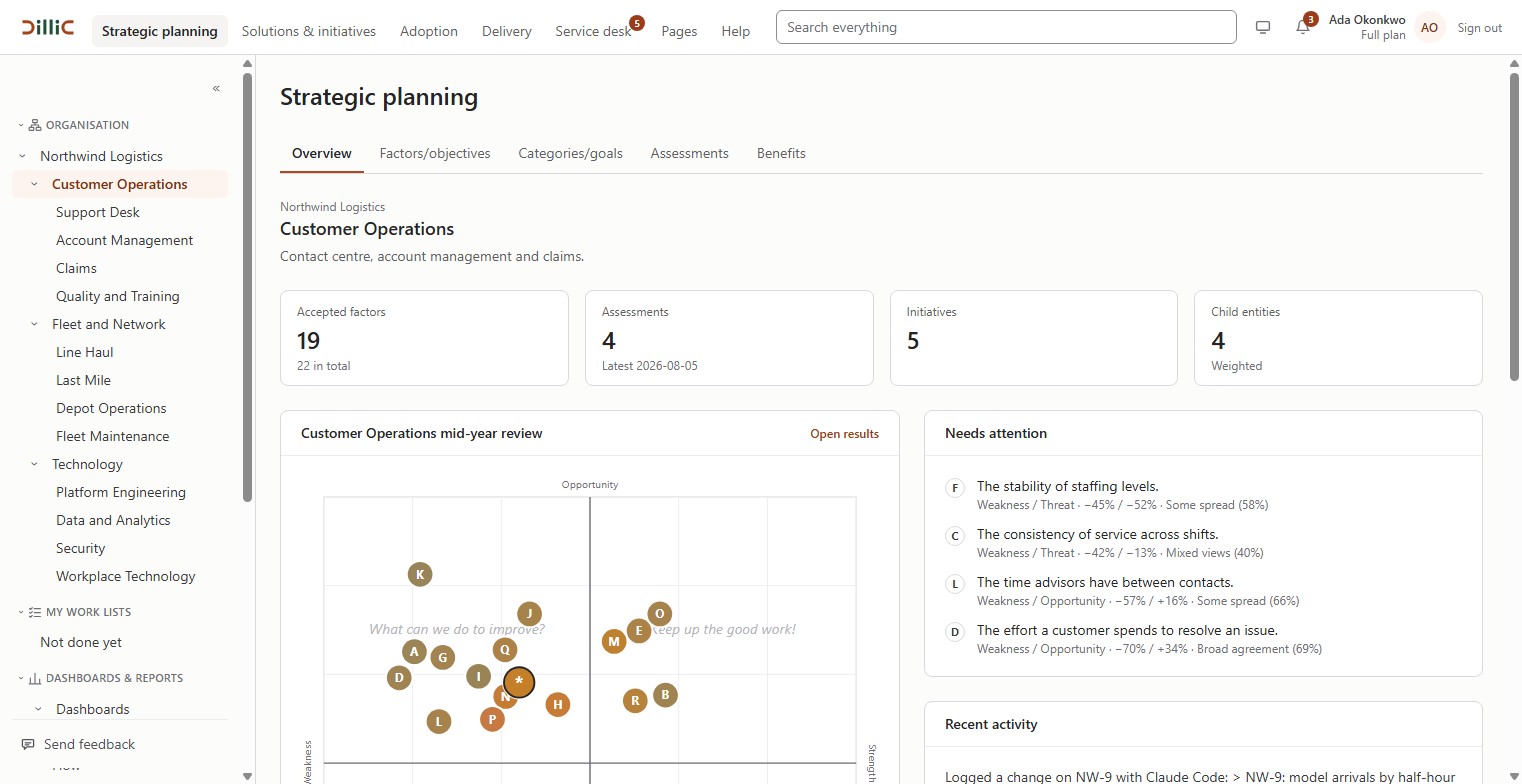
Most organisations plan in one place and deliver in another.
Strategy lives in slide decks and spreadsheets. The work lives in Jira, a service desk, and a dozen team boards. Between the two sits a gap nobody owns. Leaders cannot tell whether this quarter's work moves the goals they set, and teams cannot tell why their work matters.
DilliC closes that gap. It models the organisation as it is, from company to division to team, weighted by what each part contributes. Each part sets its objectives, assesses where it stands today, traces its problems to their root causes, and compares the options for fixing them. The initiatives that come out of that planning flow straight into delivery: Scrum and Kanban boards, sprints, risks and dependencies, ITIL change enablement, portfolio funding, and SAFe for those who run it. Every figure rolls up the hierarchy, and built-in AI analysis reads the same numbers leaders do.
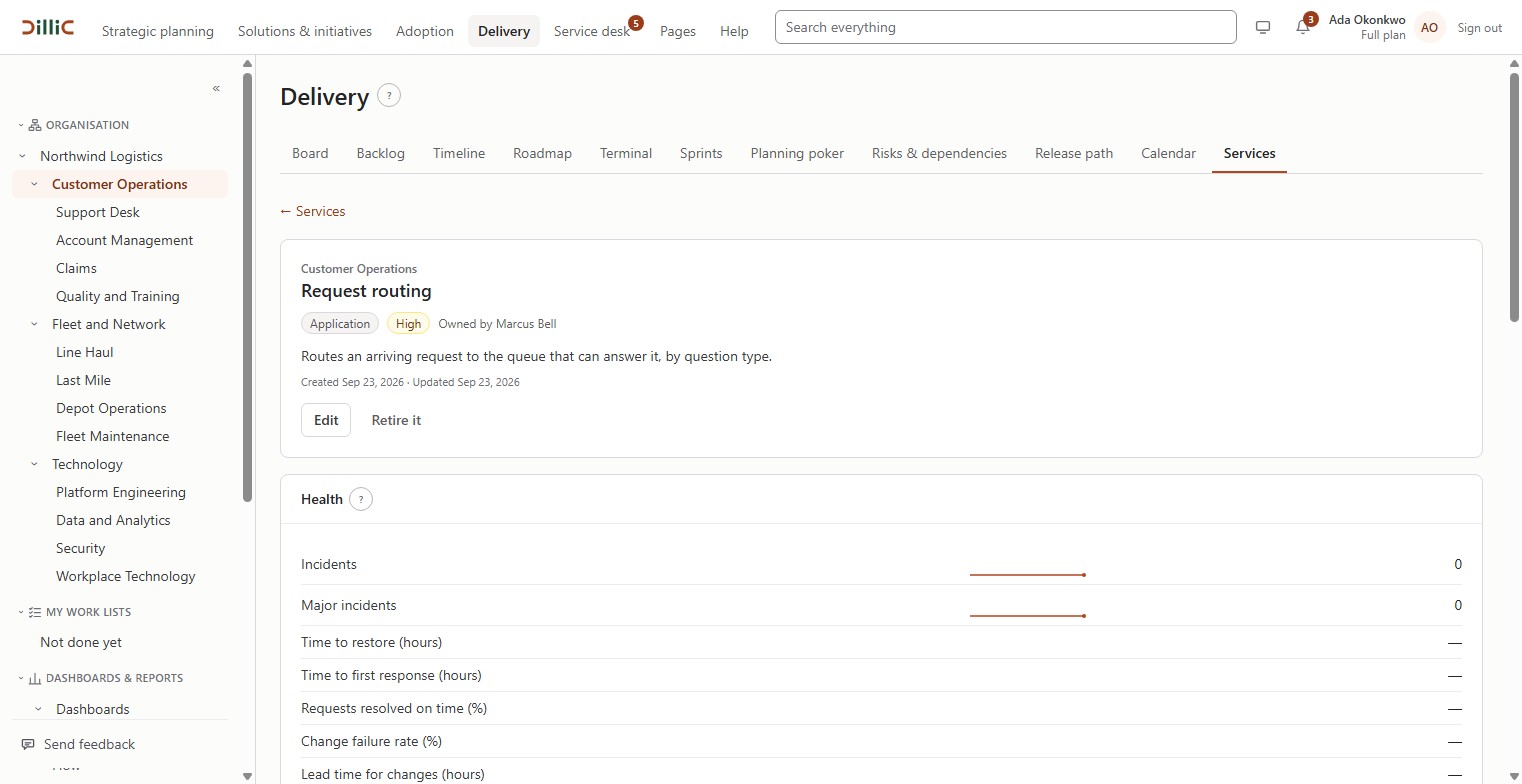
And the loop closes. The plan, the delivery, and the service desk name the same services, so a measure reads itself from the desk, an initiative is checked against what its releases touched, and a root cause cites the incidents behind it.
How it works: plan, decide, deliver, measure
Station four feeds station one. See the loop with its real numbers, from a factor in the demonstration organisation.
What DilliC includes
Two halves, one set of figures, and the modules beside them. Every plan has every one of them; the paid tiers differ only in which AI model answers.
Planning
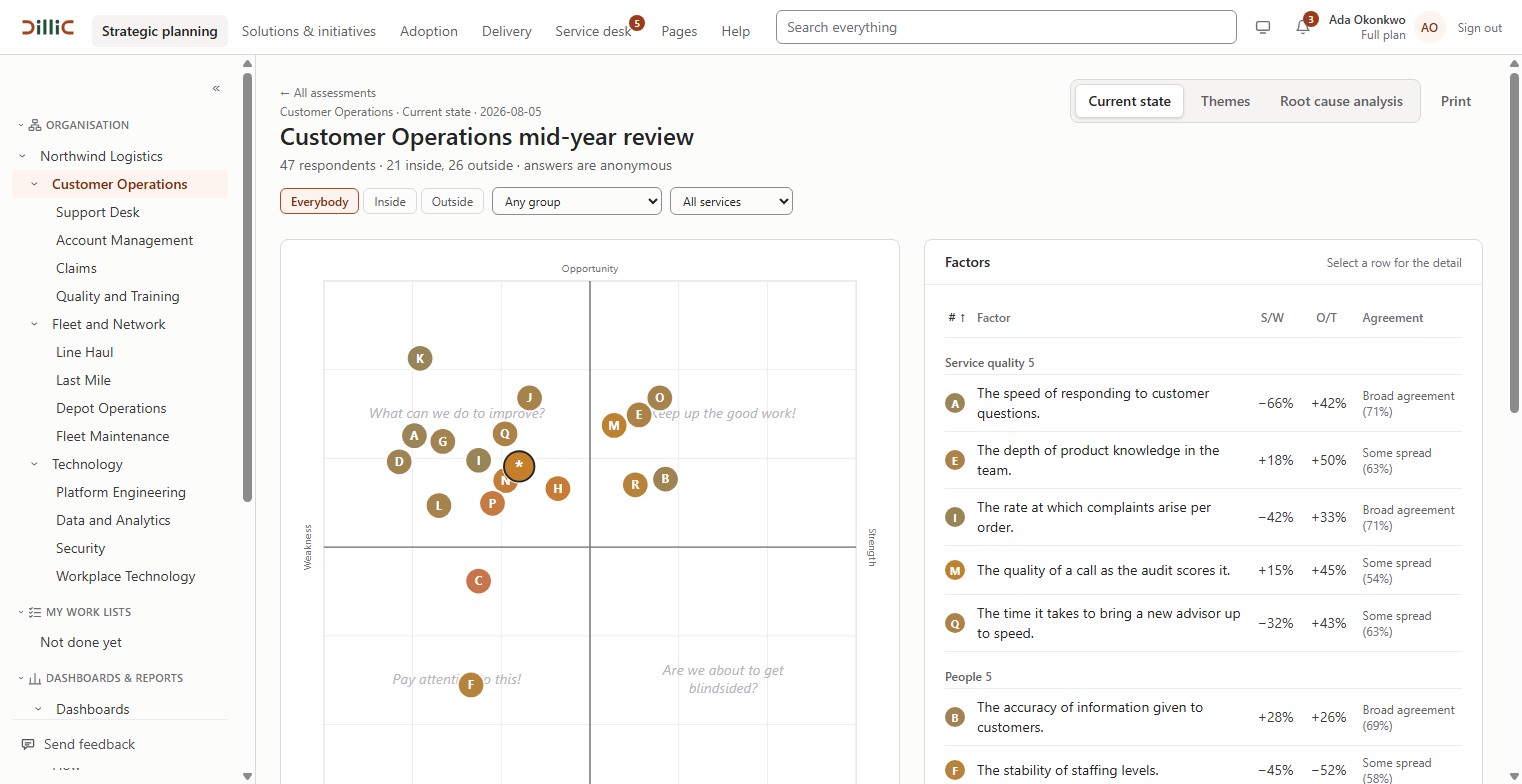
A weighted hierarchy of your organisation, factors and objectives with measures, the current-state assessment and its matrix, root cause analysis, and the comparison of futures.
Measure, explain, chooseChange management
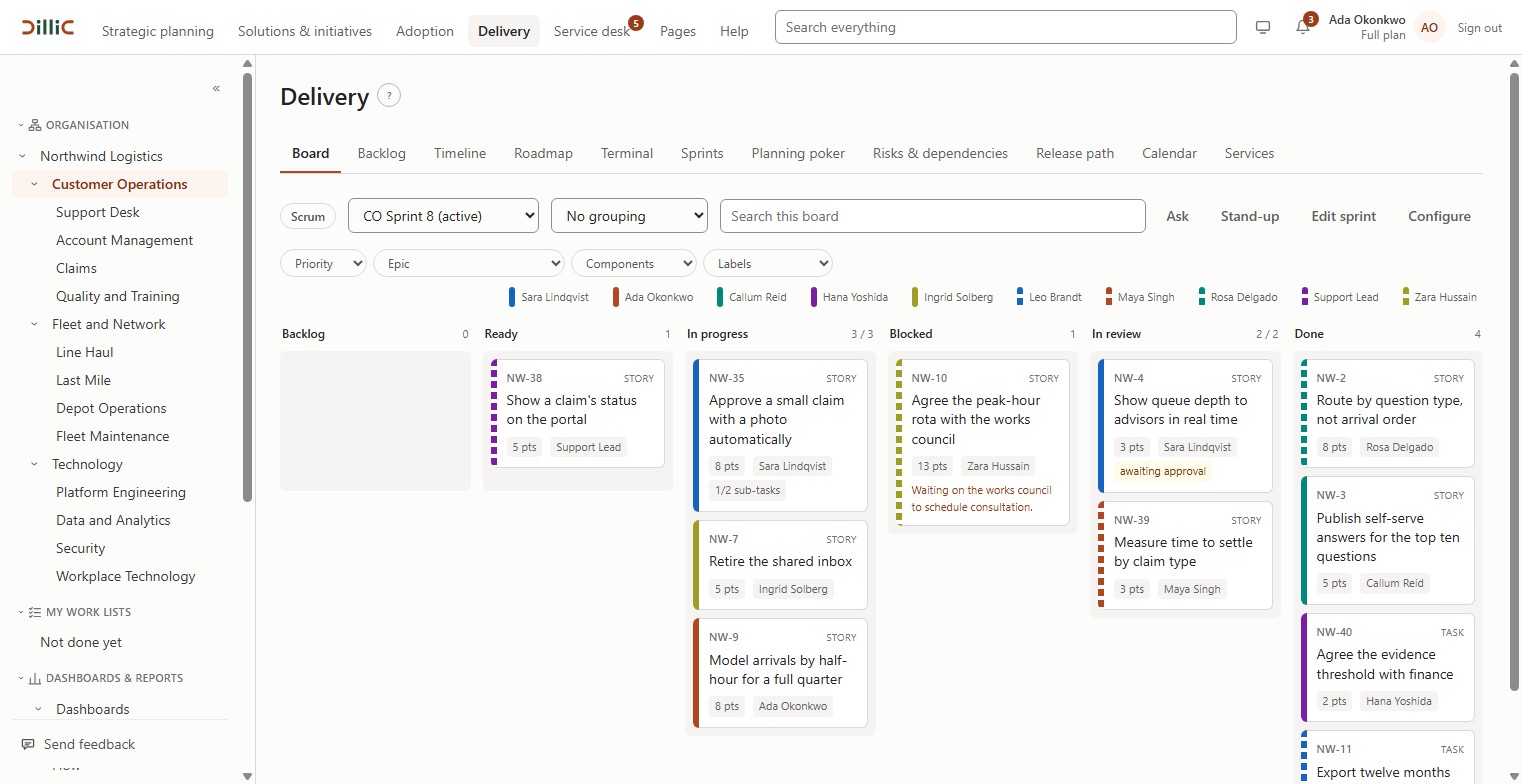
Boards, sprints and flow; a workflow engine with approval gates; risks and dependencies; ITIL 4 change enablement with a calendar, a risk questionnaire and the DORA figures.
Govern, deliver, evidenceService desk
A portal that needs no seat, queues and clocks, incidents and problems tied to the changes that caused and fix them, people on call, and ratings on what was resolved.
The deskAdoption
The people a change happens to: stakeholders on the influence-and-support grid, readiness rounds answered anonymously, the plan, the resistance log, and a saturation heatmap.
Whether it landedPortfolio
A kanban an initiative is funded through, behind a lean portfolio authority, with the hypothesis and lean business case it carries and value streams with budgets.
FundingScaling
SAFe, as much of it as you run: planning intervals, PI objectives with business value, a program board drawn from the dependencies, and predictability.
Essential to FullPages and AI
A wiki in the product, where every initiative has a page and pages answer the desk; and AI analysis over the same figures, in the seat price.
Pages, dashboards, AIEnterprise identity
SAML 2.0 and OpenID Connect single sign-on, SCIM 2.0 provisioning, passkeys and TOTP with an account-level policy, roles scoped to parts of the tree.
Signing inBeside what you have
Two-way sync with Jira, GitHub Issues and more, import and export in the vocabulary of twenty-seven trackers, webhooks from version control, and a phone app.
Trackers and the phoneThe product in three screens
One problem in Customer Operations, found, explained, delivered and read back from the desk.
It works with Jira, GitHub and the tools you have
Single sign-on and directory provisioning come standard. Two-way sync with Jira, GitHub Issues, and forty-four other trackers lets teams keep their tools and gives leadership one picture. A monitor such as Grafana or PagerDuty, or a service desk that stays where it is, raises incidents in DilliC on the service they concern. Customers and partners can answer surveys without a seat, and the whole product runs on the web, iPhone, and Android.
Who DilliC is for
Multi-entity organisations
Companies with hierarchical structures, where a division's picture has to roll up into the company's without being flattened.
Teams that need structure
Groups that want planning, prioritisation, and change management to be one process instead of three tools.
Compliance-facing businesses
Organisations requiring enterprise identity integration and audit-ready evidence of who decided what, and when.
Common questions about DilliC
What is DilliC?
DilliC is planning and change management software for organisations, offered as a hosted service. It carries work from the strategy an organisation sets to the change it ships, and back from the service desk.
Who is DilliC for?
Organisations whose divisions and teams must roll up into one picture, groups that want planning, prioritisation and change management to be one process, and businesses that must show who decided what, and when.
Does DilliC replace Jira?
It can replace Jira or run beside it. DilliC has its own Scrum and Kanban boards, sprints and service desk, and it syncs with 53 trackers, Jira and GitHub Issues among them, so a team can keep its board where it is.
What does DilliC cost?
DilliC is free during the beta, on any plan. From launch it is free for up to ten people, with no card, and the full plan costs $7, $8 or $9 a user a month, by the AI model you choose. An organisation that subscribes at that price keeps it; after launch pricing ends the full plan costs $12, $13 or $14. Every plan has every feature. See the pricing.
Does DilliC cover ITIL 4 and SAFe?
DilliC runs ITIL 4 change enablement, with a change calendar, approvals, a risk questionnaire and the DORA figures, and as much of SAFe as you run. The ITIL map and the SAFe map grade the product against each framework.
Try the loop on your own numbers. A two-week trial on the free plan takes one part of your organisation from a measured problem to an initiative on a board, and shows the sponsor a chart with your service's name on it.